

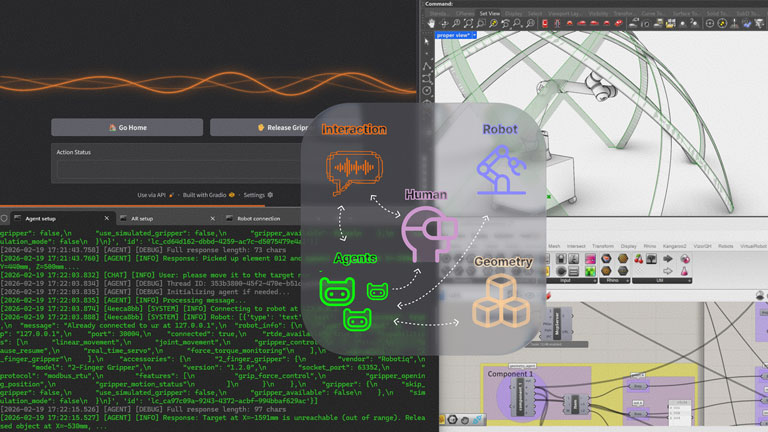
This workshop introduces you to AI agents for collaborative robotic construction. These agents can reason and act on inputs from the environment. Over three days, you will learn how these agents work, where they fail, how to make them useful, and how to apply them in your own domain. You will also gain hands-on knowledge and insights by building a timber structure with a robot driven by AI agents .
The workshop covers four things:
Context-building Agents are only as good as the information you give them. You will learn to feed geometry, material properties, and assembly logic into a multi-agent system — and see directly how the quality of that context changes the agent’s output.
Grounding AI agents hallucinate. In a text conversation that’s annoying; in construction it can be dangerous. You will learn the principles behind building tools that translate physical constraints (reach envelopes, joint limits, material behaviour) into information the agent can reason about, closing the gap between digital reasoning and physical reality.
Multi-modal interaction Agents interact with you beyond spoken commands, using embodied inputs such as your gaze and movement to infer intention. Wearing AR headsets while collaborating with the robot, you will experience this firsthand.
Human control. How does the system interpret your intention? The workshop is built around keeping humans in meaningful control. We will explore what that looks like in practice, and how the answer may vary by field.
On the final afternoon, we step back from the specific system and ask: what would an agent look like in your workflow? Together, we will also reflect on how agents can be used in your workflow, identifying what context an agent would need, where it could be trusted, and where it should not be. These conversations tend to be where the most transferable thinking happens.
Prior experience with robotics or programming is not required but highly encouraged, as it will deepen your engagement with the material. You will need Rhino 7 or 8 with Grasshopper installed.
By the end of three days, participants will have experienced shared spatial context with a collaborative robot and an agentic team through AR, understood the principles behind grounding agents in physical reality, and mapped these workflows onto their own practice. The structure they helped build will be on display at the conference.

Workshop Takeaways
- Embodied agents: Agentic LLMs control physical robots by reasoning about spatial data to execute physical actions.
- Context Engineering: Participants learn to build an effective context for multi-agent systems using multimodal interaction to reduce AI hallucinations.
- System Architecture: Attendees will learn best practices for designing collaborative agentic scaffolds, including agent prompts, tool design, and grounding techniques.
Participant take aways:
- Context-aware Interaction with AI Agents: Attendees will observe how agents use multimodal embodied inputs, such as gaze and movements, to deduce human intentions. They will also learn to construct the data environments that ground these agents and reduce errors. This demonstrates how to move beyond explicit prompt instructions to create context-aware machine colleagues.
Expected Outcomes
- Physical Exhibition Structure: The group will construct a shell structure in collaboration with a UR10 robot. This structure will be on display at the RobArch 2026 conference.
- Workflow Translation: Attendees will map collaborative AI methods to their specific disciplines. Discussions highlight how to build trust by grounding agent outputs in deterministic simulations, and how to retain human control over the crafts and creative processes.
Juan David Frank
Juan David Frank is a research associate at ICD Stuttgart, working on generative AI applied to architectural design. His research focuses on AI-based support systems during early design stages, particularly on how agents based on LLM reasoning can aid computational designers when data might not be fully structured and design options not fully detailed.

Xiliu Yang
Xiliu Yang is a postdoctoral researcher at ICD and MPI-IS in Stuttgart. Her research focuses on augmented reality interfaces and human-centred workflows for collaborative robotic construction, combining spatial interfaces with embodied human-machine interaction. She also leads the human-machine collaboration research group at the ICD.

Lasath Siriwardena
Lasath Siriwardena is a research associate at ICD Stuttgart and a member of the Cluster of Excellence IntCDC. His research focuses on agent-based modelling for segmented timber shell structures, which is being applied to the ongoing development of the IntCDC Building project. He has extensive expertise in robotics and computational workflows for design to assembly.