


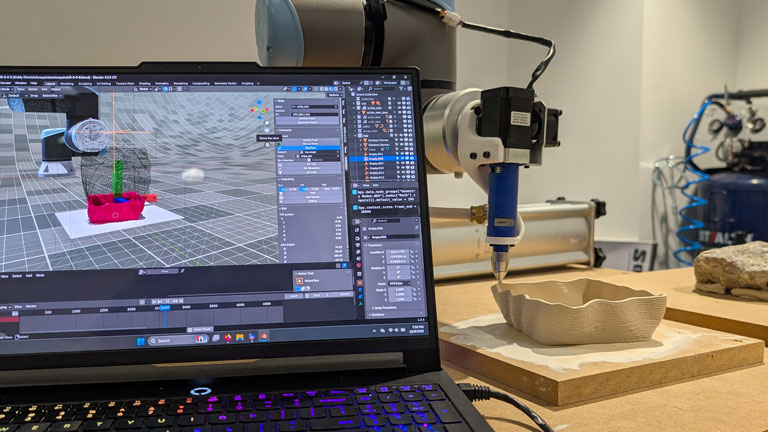
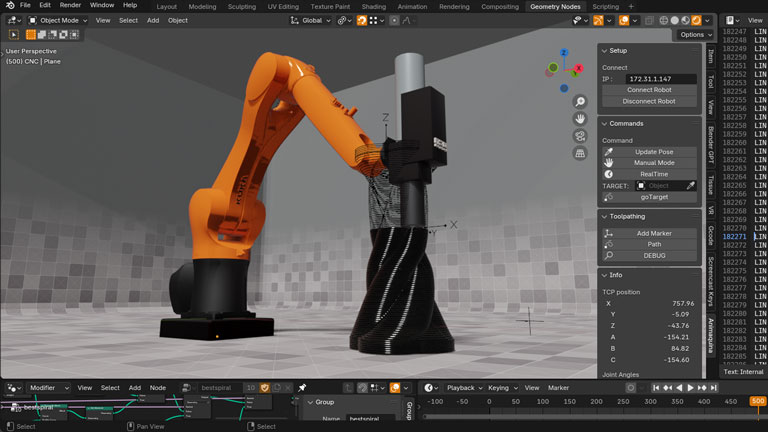
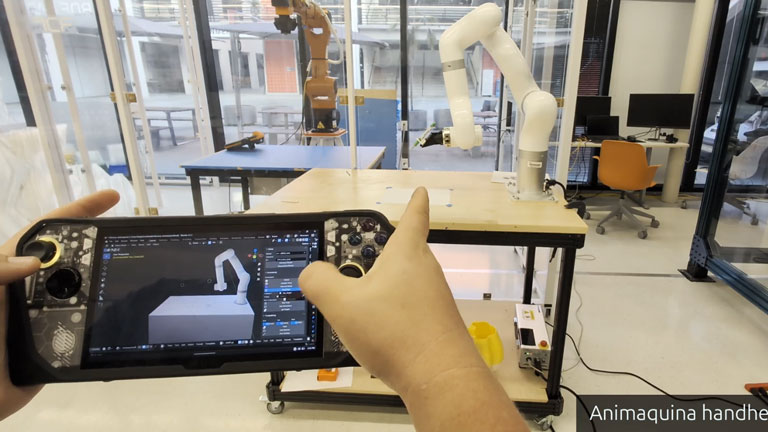
This three-day workshop introduces participants to an open and modular approach for robotic integration that bypass hardware restrictions common to industrial robots. Using Animaquina, a Blender-based tool developed for robotic control, participants will learn how to program, simulate, and interact with industrial robots through real-time data exchange.
The workshop focuses on building workflows that decouple integration between robots and end-effectors, allowing new tools, sensors, and actuators to be easily added using MQTT communication. This approach enables quick testing and iteration, making robotic workflows more adaptable, material-aware, and human-centered.
Concept and Relevance
The workshop responds directly to the ROB|ARCH 2026 theme, Detangling Dependencies, by rethinking how creative robotics can operate beyond brand-specific or single-purpose frameworks. Most robotic fabrication workflows rely on rigid software that tightly couples motion control with end-effector operation. This limits experimentation and slows adaptation to new tools or materials.
Through Animaquina, participants will explore a simplified integration model that separates these layers—robot motion, tool operation, and sensor feedback—into modular components connected through open protocols. They can generate, modify, and re-test robot paths instantly inside Blender, dramatically reducing iteration time.
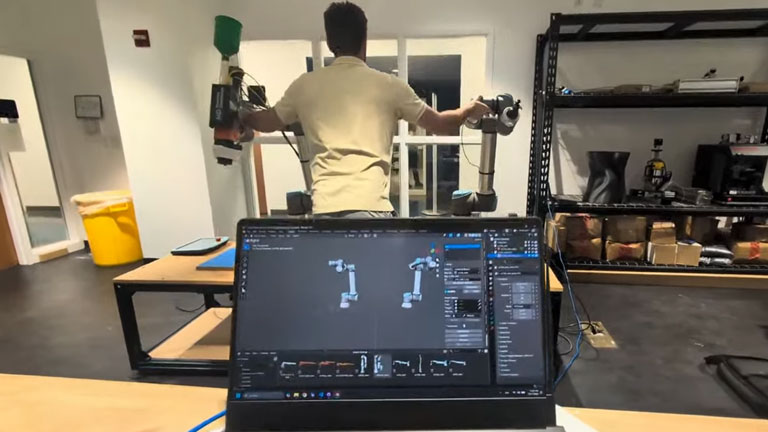
This modular and open-source approach encourages flexible experimentation across art, design, and fabrication. Participants will work hands-on with physical robots and digital twins, developing workflows that bridge simulation, material response, and real-time interaction.
Workshop Takeaways
Learn how to decouple end-effector integration from proprietary robot environments.
Build robotic fabrication systems using open-source software (Blender + Animaquina) and MQTT for real-time communication.
Test and iterate workflows quickly
Expand to new sensors and actuators
Develop human-in-the-loop, material-aware, and context-aware closed-loop systems.
Participants
- Designed for architects, artists, and engineers.
- Laptops (Windows preferred)
- Participants should install Blender and the Animaquina add-on (provided)
- Familiarity with Arduino , Python or visual programming is helpful but not required.
Expected Outcomes
By the end of the workshop, participants will develop a working prototype of an interactive robotic workflow + end effector. Each project will integrate motion design, live control, and custom end-effectors or sensors. Examples may include live drawing robots, adaptive fabrication, or human centered interaction. Final projects will be documented and presented during the ROB|ARCH exhibition.
Luis Arturo Pacheco – Lead instructor
Luis Arturo Pacheco is an Assistant Professor of Architecture at Florida Atlantic University and Director of the Interactive Machines Lab, where he leads research at the intersection of computational design, robotics, and digital fabrication. His work focuses on developing intuitive robot control interfaces for creative professionals and advancing novel workflows for large-scale and construction-oriented digital manufacturing. He is also a Doctor of Design candidate at Florida International University, where his dissertation investigates procedural robot control, modular hardware integration, and interface design for architectural robotics.
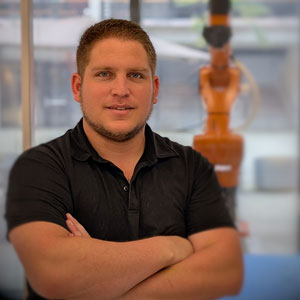
Karl Singline
A researcher and practitioner working at the intersection of robotics, architecture, and digital fabrication. His work focuses on making industrial robotics more accessible to designers through state-of-the-art tools, real-time simulation, and integrated digital workflows. He has led workshops and projects internationally across education, research, and industry, exploring robotic fabrication, human–robot interaction, and construction-scale applications.
