

Actionable Repair is a hands-on collaborative robotics workshop that explores how multimodal AI and human–robot cooperation can make repair accessible, systematic, and creatively open-ended. The workshop connects high-level repair design with situated robotic perception, planning, and action. Its central contribution is a Multimodal Reasoning-to-Action workflow that translates textual observations, visual documentation, and geometry files of a building structure into a structured Assembly Model describing components, connections, and damage states.
This model serves as the basis for exploring repair designs and generating an Action Model that contains structured repair sequences combining human- and robot-executable actions. These designs are created through structured prompting containing defined roles, repair goals, and constraints such as available tools, materials, and robotic capabilities.
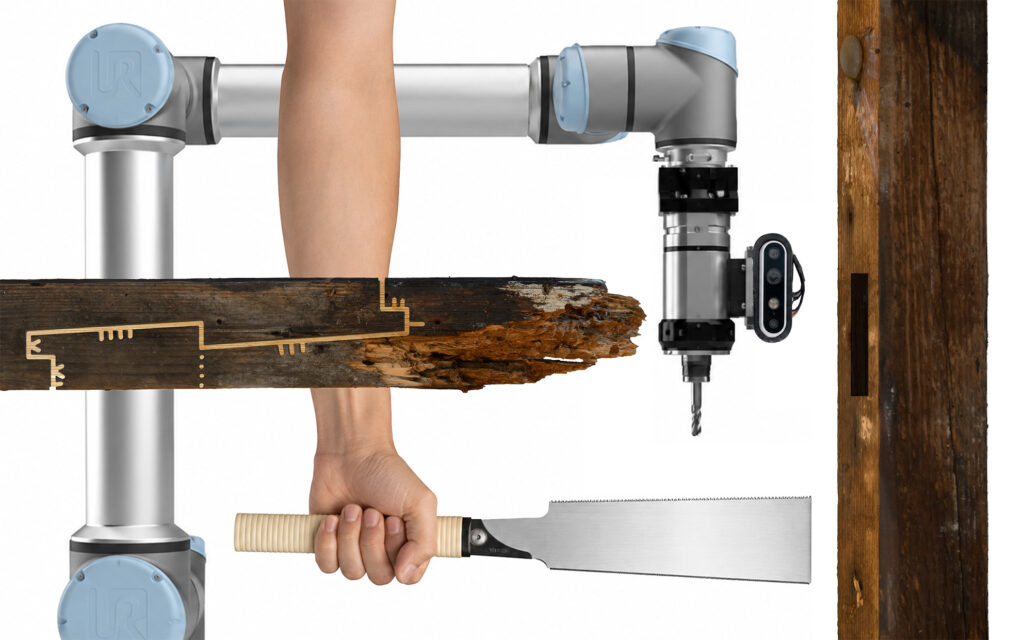
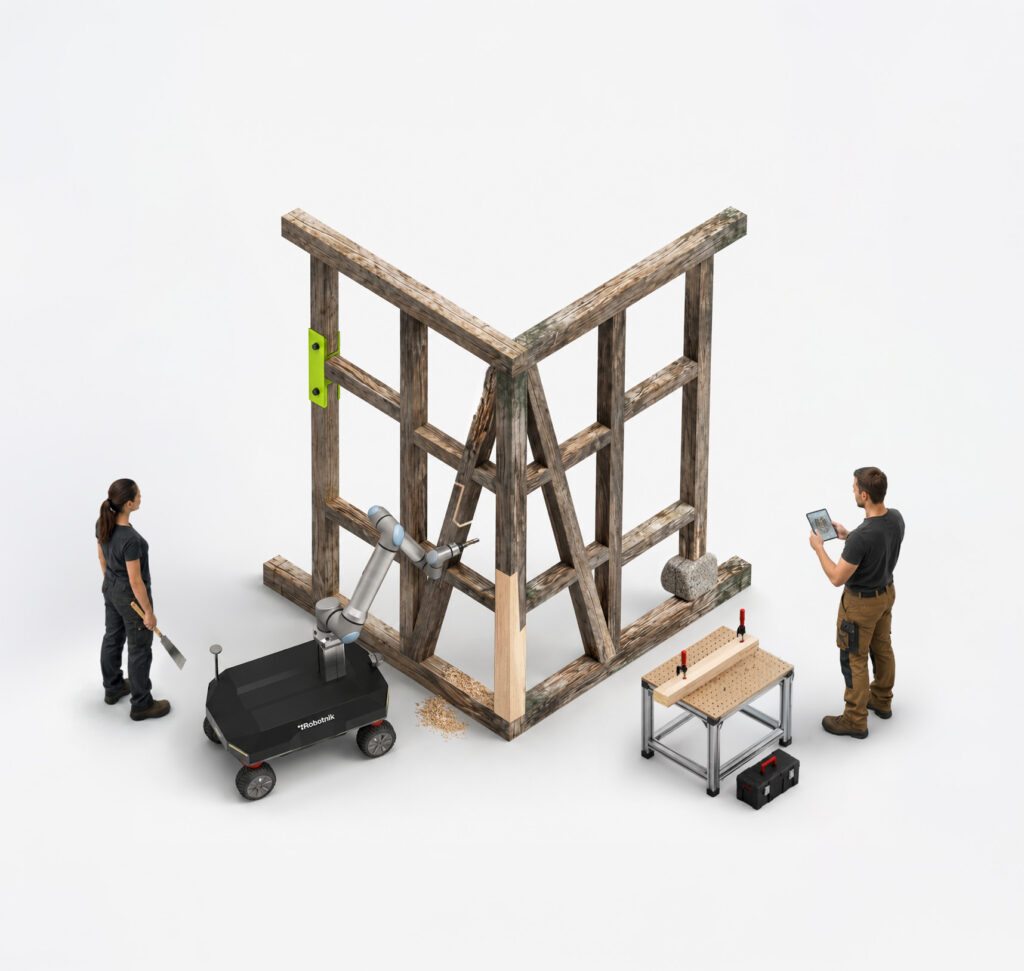
Robotic perception, planning, and control routines enable precise operations such as scanning, marking, or milling, while complementary repair steps, including material removal, surface treatment, or assembly, are performed manually.
As a case study, participants will engage with the repair of a curated set of damaged beams in a half-timbered wall. They will prototype collaborative repair interventions through iterative cycles of planning, manual and robotic execution, and evaluation. The workshop concludes with a repaired building structure and documented digital records of the workflows and outcomes.
Workshop Takeaways
- Multimodal diagnostics — turn text, images, and scans into graph-based Assembly Models
- Language-to-action planning — generate Action Models linking repair intent to parts, constraints, and candidate toolpaths
- Verifiable fabrication — apply the scan-after-cut loop to derive fit
- Human–robot collaboration — allocate roles by comparative advantage and define the safety and feedback loops for in-situ execution
Participant take aways:
- Run and iterate the AI workflow to produce Assembly and Action Models
- Plan and execute robot-enabled actions (scanning, marking, stabilisation, milling), kinematics, end-effectors, and workspace
- Develop constrained, stepwise repair sequences with various outcomes
- Test and refine interventions by making and evaluating
Expected Outcomes
- Executable Strategies: Distinct and repeatable repair instructions for human and robot execution
- Robot Toolpaths: Candidate paths generated with LLM support plus simulation validated programs
- Physical Prototypes: Repaired artefacts and one structural element scenario
- Digital Records: Saved Assembly- and Action-Models plus documentation
Tizian Rein, M.A.
Tizian Rein is an architect and doctoral researcher bridging computational design, artificial intelligence and building preservation. During his Master‘s studies, he gained research experience in robotics at TU Munich and ETH Zurich. He is currently a doctoral researcher at the Professorship of Digital Fabrication within the Munich Institute for Robotics and Machine Intelligence (MIRMI) and MIT, USA.
Begüm Saral, M.A.
Begüm Saral is an architect and doctoral researcher specializing in mobile robotics and AI for construction and deconstruction, focused on material reclamation and reuse. She studied at Istanbul Technical University and TU Munich, where she completed her Master’s degree in architecture in 2022. She is currently conducting her research at TUM GNI within the SPAICR project, focusing on implementations of spatial AI for cooperative construction robotics.

Lidia Atansova, Dr.
Lidia Atanasova is an architect and postdoctoral researcher in computational design and digital fabrication. She studied at ITECH University of Stuttgart and TU Wien, earning her Master’s degree in architecture, and worked at TU Wien and in offices in Stuttgart and Vienna. At TUM, she completed her PhD on Human Robot Cooperative Assembly within the CoConstruct innovation network.

Avishek Das, Dr.
Avishek Das is an architect and postdoctoral researcher in robotic and digital fabrication, human–robot collaboration, and XR in design. He studied at Jadavpur University and CEPT University and earned a Fab Academy diploma. He worked as a research Assistant and completed a PhD at Aalborg University, held a postdoc at Aarhus University, and since 2025 is a postdoc at TUM within DFG FOR 5672.