


This workshop invites participants to rethink robotic 3D printing as a responsive and evolving process.
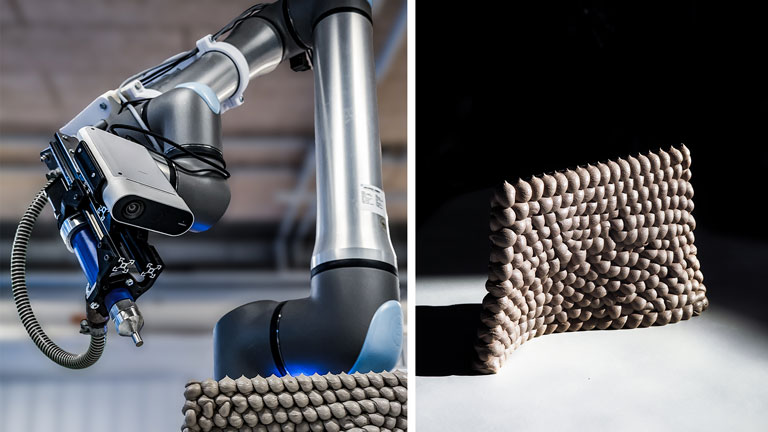
Over three days, attendees work in small teams to develop and test an adaptive clay-printing workflow using a collaborative robotic arm and integrated RGB-D sensing. Rather than executing fixed toolpaths, as is typical in additive manufacturing, the robot continuously captures the state of the emerging artefact and adjusts its deposition strategy accordingly. This enables evolving geometries through event based fabrication.
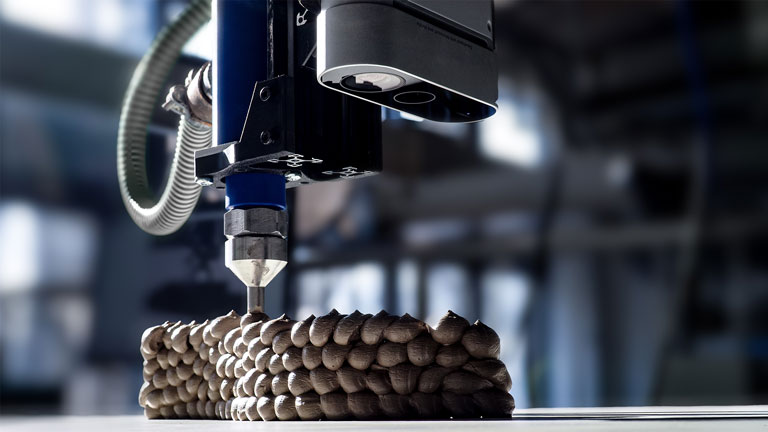
The workshop employs Discrete Deposition Modelling, an additive fabrication approach structured around incremental bead-scale deposition. After each sequence of material placement, the system scans the current geometry, reconstructs it as a three-dimensional model, and evaluates spatial conditions before computing the next set of robotic actions.
Participants set up and calibrate a robotic clay extrusion system, integrate vision sensing into the fabrication loop, and experiment with rule-based behaviours that modify toolpaths in response to detected changes. Each group tackles a unique adaptive printing strategy and produces a series of small-scale clay artefacts whose geometry evolves throughout the fabrication process.
Throughout the session, teams experiment with:(i) real-time geometric scanning and reconstruction; (ii) feedback-driven toolpath generation; (iii) behaviour-based deposition logics; (iv) Iterative fabrication cycles linking sensing and action.
By the end of the workshop, participants gain hands-on experience with closed-loop robotic fabrication workflows and explore how additive manufacturing can operate as an open, reactive system rather than a fixed sequence of commands.

Workshop Takeaways
- Discrete Deposition Logic: Understanding bead-scale additive strategies and discretisation principles.
- Robot Calibration: Hands-on setup and refinement of clay extrusion parameters for stable deposition and sensing.
- Sensing Integration: Implementation of RGB-D scanning pipelines and interpretation of reconstruction limits and uncertainty.
- Feedback-Driven Toolpaths: Development of rule-based behaviours informed by scanned geometry.
- Iterative Fabrication Cycles: Experience in linking sensing, evaluation, and robotic action within a closed-loop workflow.
- Behavioural Framework: Exploration of additive manufacturing as a responsive and autonomous system rather than a fixed command sequence.
Expected Outcomes
- Primitive to Adaptive Artefacts: A progression of printed prototypes, beginning with deterministic primitive geometries and evolving toward responsive printing strategies.
- Operational Closed-Loop Setup: A functional sensing–analysis–printing pipeline implemented on a collaborative robotic arm.
- Behavioural Growth Strategies: A series of rule-based fabrication tests demonstrating how scanned data influences geometric growth.
- Documented Adaptive Strategies: Clear articulation of the relationship between sensing input, heuristic evaluation, and robotic action developed by each team.
Joseph Naguib
Joseph Naguib is PhD Fellow at SDU CREATE, where he develops adaptive robotic 3D printing systems that integrate sensing and feedback into architectural fabrication. His research centres on stimulus-driven additive manufacturing, enabling robotic deposition processes that respond to environmental and spatial input in real time. He holds advanced degrees in robotics and digital construction and has worked on large-scale earth and concrete printing projects. His research contributions address process control, material performance, and responsive fabrication methodologies.

Lucas Helle Pessot
Lucas Helle Pessot is PhD Fellow at SDU CREATE, researching behavioural frameworks for autonomous robotic 3D printing. His work investigates behaviour-driven additive manufacturing using industrial robotic arms and custom extrusion systems, with emphasis on material-informed fabrication strategies. He holds an MSc in Design Sciences and combines a background in design engineering with research in robotics and digital fabrication. His projects and publications examine the integration of vernacular construction logic, adaptive processes, and computational control in architectural production.

Özgüç Bertuğ Çapunaman, PhD
Özgüç Bertuğ Çapunaman is a Postdoctoral Researcher at SDU CREATE, working at the intersection of robotics, machine perception, and learning based systems. He completed his PhD in Architecture at Penn State University, where he developed vision-augmented methods for advanced robotic fabrication. His research focuses on fabrication platforms capable of sensing, interpreting, and adapting to dynamic material conditions. He has presented and published his work internationally and received the Young CAADRIA Award in recognition of his contributions to computational design research.

Roberto Naboni, PhD
Roberto Naboni is Associate Professor in Computational Design and Digital Fabrication at the University of Southern Denmark, where he leads SDU CREATE and serves as Head of the MSc CREATE programme. He received his PhD with honours from Politecnico di Milano. His research advances sustainable architectural practice through design computation, construction robotics, and material experimentation. He has authored ~100 publications and is the Research Field Lead for Digitalisation and Automation in Construction within the national initiative CEBE.
