

Biopolymer composites are sustainable, locally sourced materials, but notoriously difficult to control. Their rheology shifts with temperature, humidity, and mixture, making robotic 3D printing with them inherently unpredictable. Rather than treating this as a problem to solve, this workshop treats it as a design opportunity.
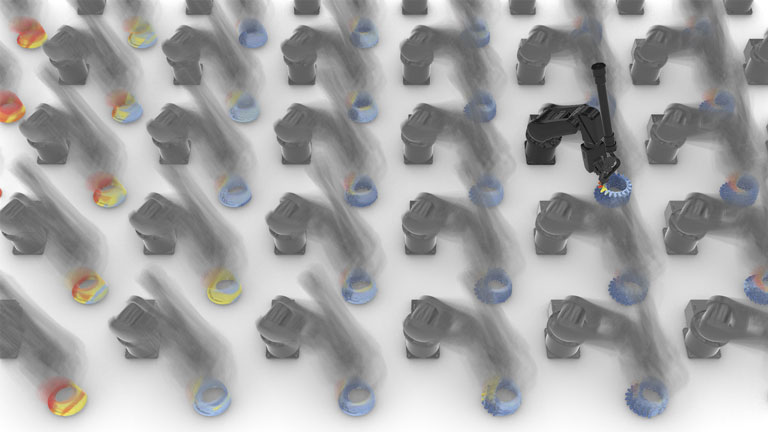
Over three days, participants will work with a pretrained reinforcement learning (RL) system developed to adapt robotic toolpaths in response to the live behavior of biopolymer materials. The RL model doesn’t override design intent — it refines it, acting as a partner that learns to work with material instability rather than against it.
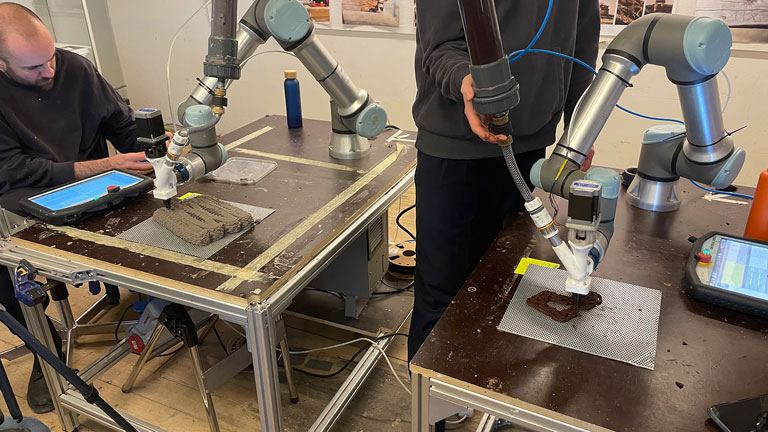
Working in small groups, participants will design geometries that push material and geometrical limits and print each design twice: once from the original toolpath, and once after RL evaluation and correction. A scan-to-digital comparison tool will make the difference visible, revealing how machine learning mediates between intention and physical outcome.
No prior experience with machine learning is required, though familiarity with Rhino or Grasshopper is helpful. Participants should bring a laptop with Rhino 8 and Anaconda installed, as well as clothes they don’t mind getting dirty.

Workshop Takeaways
- Examine how biopolymer composites behave as dynamic, environmentally responsive systems and why their rheological instability is a design variable rather than a defect.
- Investigate how variations in biopolymer composite recipes produce distinct rheological profiles and surface behaviors under robotic extrusion.
- Understand how RL models are trained on simulations to anticipate material deviation and propose adaptive toolpath corrections.
- Evaluate side-by-side printed outputs, pre- and post-RL correction, to make learning-based feedback spatially legible.
- Use 3D scanning and overlay analysis to compare intended geometry, simulated prediction, and physical print outcome across a single feedback loop.
Participant take aways:
- Design of challenging print geometries, such as overhangs, compression zones and collapse-prone features, that deliberately probe the limits of material and model.
- Hands-on printing with multiple composite recipes, developing material intuition for how mixture variations influence flow, adhesion, and structural behavior.
- Direct interaction with a pretrained reinforcement learning system: submitting toolpaths, receiving corrections, and interpreting the model’s adaptive logic.
- Development of critical literacy around how machine learning mediates between designer intent, material behavior, and fabricated result.
Expected Outcomes
- A set of before/after toolpath comparisons demonstrating how RL correction influences both geometric accuracy and expressive material character.
- A cross-group record of printed samples documenting how different biopolymer formulations respond to identical geometries and toolpath strategies.
- A spatial record, aligned scans, simulations, and prints, that traces the gap between digital prediction and physical behavior across multiple geometries.
Carl Eppinger
Carl is a PhD candidate at the Center for IT and Architecture(CITA) at the Royal Danish Academy – Architecture, Design, Conservation. His doctoral focuses on Machine Learning supported adaptive robotic fabrication of graded biopolymer composites for architectural use. With it’s main goal to enhance the quality, precision and success rate of robotic biopolymer 3D printing, creating a more easily applicable system for the use of Biopolymer composites in the construction industry. Before starting his PhD, Carl was a Research Assistant contributing to CITA’s biopolymer research projects. Carl holds a Master of Architecture and a Master of Science in Architecture Design and Research from the University of Michigan.

Andreea Bunica
Andreea is a Research Assistant at CITA, where she develops adaptive fabrication systems for biomaterial robotic 3D printing. In parallel, she is the founder of PAW- an innovation studio with projects across fashion technology, construction, textiles, furniture and jewelry manufacturing.
Her work operates at the intersection of robotics, computation, and object manufacturing systems, aiming to bridge academic research and applied industrial innovation. Andreea holds a Masters of Robotics and Advanced Construction from the Institute of Advanced Architecture of Catalonia