

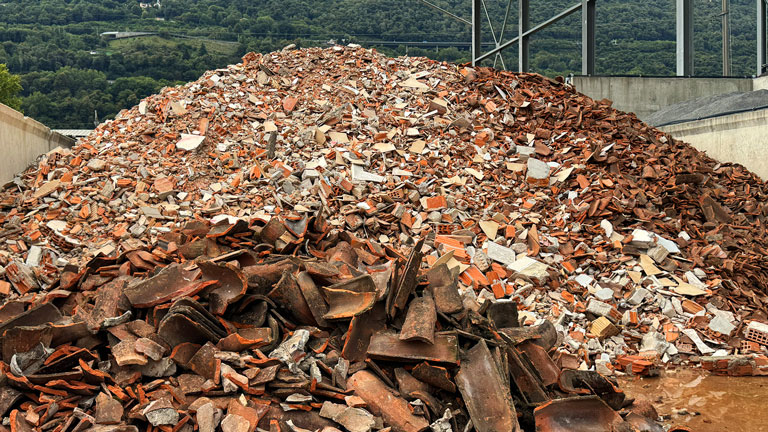
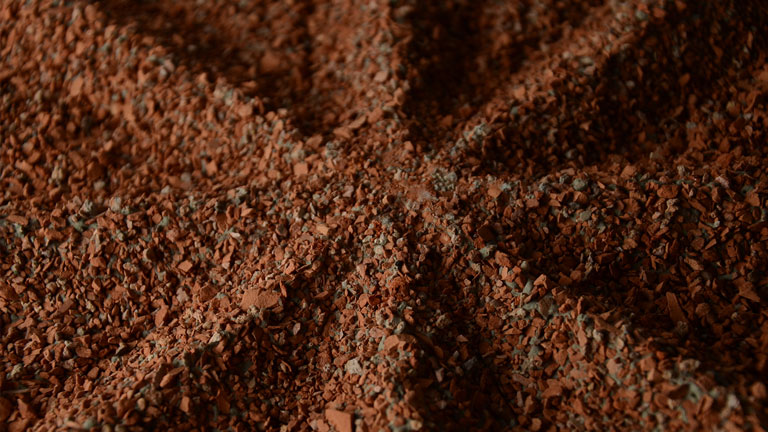
Granular Dependencies investigate how robotic fabrication can engage with the unpredictable nature of granular waste to establish a new framework for an adaptive and sustainable formwork for concrete casting. The workshop addresses one of the most pressing challenges in architecture and construction: the excessive material use and CO₂ emissions embedded in standard concrete processes.
In conventional practice, the geometric limitations of standard formworks result in concrete elements that use far more material than structurally necessary. While digitally optimized geometries can minimize material use, they often require complex formworks that are costly or wasteful. By employing granular waste as a reconfigurable medium, this workshop proposes an alternative circular formwork system. However, the use of heterogeneous waste introduces new dependencies—between material behavior, precision, adaptability, structural performance, and surface aesthetics. The workshop foregrounds these relationships; and the formwork becomes an active field that registers the negotiation between robotic precision and material agency.
The process employs custom-designed 3D-printed end-effectors mounted on a robotic arm, which performs toolpaths over granular waste beds. Each pass modifies the surface geometry according to defined parameters while variations in material composition and moisture content alter the cohesion and deformation of the substrate. After each step, the resulting topography is digitized using a depth scanner, producing a detailed height map that participants will use to detangle the multiple factors shaping the surface form. This feedback loop between design intent and material outcome generates a growing dataset that reveals the dependencies between robotic parameters and the behavior of granular matter. Through this data-driven approach, the participants have the opportunity to adapt their strategy in response to material feedback, moving beyond a paradigm of control toward one of negotiation and co-evolution.
Over three days, participants will work in small groups to design and cast 30 × 30 cm concrete elements. Participants will explore different granular compositions and shaping strategies, generating their own data and aesthetic outcomes. Each group will define both their own panel and the visual and physical connections with neighboring pieces, emphasizing collaboration and interdependence at multiple scales.
Developed by the Fabrication and Material Aware Architecture (FMAA) group at the Accademia di Architettura, USI Granular Dependencies redefines the role of granular waste by transforming it from a passive residue into an active design medium.


Workshop Takeaways
- An understanding of circular formwork systems using granular waste.
- Insight into the relationship between material behavior and fabrication parameters.
- Exposure to the fabrication and material aware design methodology.
- Hands-on experience with robotic fabrication and concrete casting.
- Experience in collaborative design and assembly of a modular panel system.
Participant take aways:
- The workshop is intended for:
- Early-career researchers interested in digital fabrication and sustainable construction.
- Undergraduate and graduate students in architecture, design, and engineering.
No prior robotic experience is required, but familiarity with Rhinoceros 3D and Grasshopper is beneficial. Participants should be comfortable working collaboratively and engaging in experimental, hands-on processes.
Expected Outcomes
- An understanding of circular formwork systems using granular waste.
- Insight into the relationship between material behavior and fabrication parameters.
- Exposure to the fabrication and material aware design methodology.
- Hands-on experience with robotic fabrication and concrete casting.
- Experience in collaborative design and assembly of a modular panel system.
Sevgi Altun, USI
Sevgi Altun is a PhD researcher at the Fabrication- and Material-Aware Architecture (FMAA) group at the Accademia di architettura di Mendrisio, USI. Her research investigates the use of granular waste as reconfigurable formwork for structurally optimized concrete elements. Previously, she worked as a research assistant at The Chinese University of Hong Kong on the “AI for the Future” project. She holds an MSc in Architectural Design Computing from Istanbul Technical University, where she also served as a research assistant from 2020 to 2023.

Giorgio Castellano, Politecnico di Milano
Giorgio Castellano is a researcher at Politecnico di Milano (ABC Department), within the Material Balance group, and a visiting researcher at the Accademia di Architettura di Mendrisio (USI). In 2020 he established Baka Studio as an independent research and design platform. Previously, he worked as an Architectural Designer at Sou Fujimoto Architects (Tokyo), Studio Fuksas (Rome), and MAD Architects (Beijing).

Ena Lloret Fritschi, USI
Professor Dr. Ena Lloret-Fritschi is an architect specialising in digital concrete and fabrication-aware architecture. At the Accademia di architettura di Mendrisio, Università della Svizzera italiana (AAM-USI), she leads a research group dedicated to Fabrication- and Material-Aware Architecture, developing holistic design methodologies that integrate material behaviour, fabrication processes, and structural performance. Through research on construction materials, including concrete, stone, and earth, her work aligns design with material and fabrication constraints to reduce material consumption while expanding architectural possibilities. Lloret-Fritschi received her PhD from ETH Zurich with the thesis Smart Dynamic Casting, pioneering digitally controlled processes for non-standard concrete structures. She currently serves as Director of the Institute for Sustainable Architecture and Technology (IAST) at AAM-USI.