


The construction industry is experiencing a persistent shortage of skilled labor, high employee turnover, and rising demand, resulting in pressure on production workflows. At the same time, expectations for efficiency, precision, and adaptability are increasing. While cyber-physical systems and collaborative robotic technologies offer promising solutions, their adoption in construction remains limited. Challenges such as system inaccessibility, low resilience to uncertainty, and concerns over trust and safety have slowed integration, preventing the field from benefiting from the precision and efficiency that robotics can provide. Construction sites are inherently dynamic environments. They involve constantly changing spatial conditions, material variations, and continuous human activity.
Traditional robotic workflows, developed for controlled industrial settings, rely on rigid scripts that quickly fail when conditions shift. As a result, many robotic fabrication applications remain impractical for real-world construction. To support the industry’s shifting needs and to address workforce shortages, robots must be able to collaborate meaningfully with humans, automatically respond to uncertainty, and adapt in real-time.
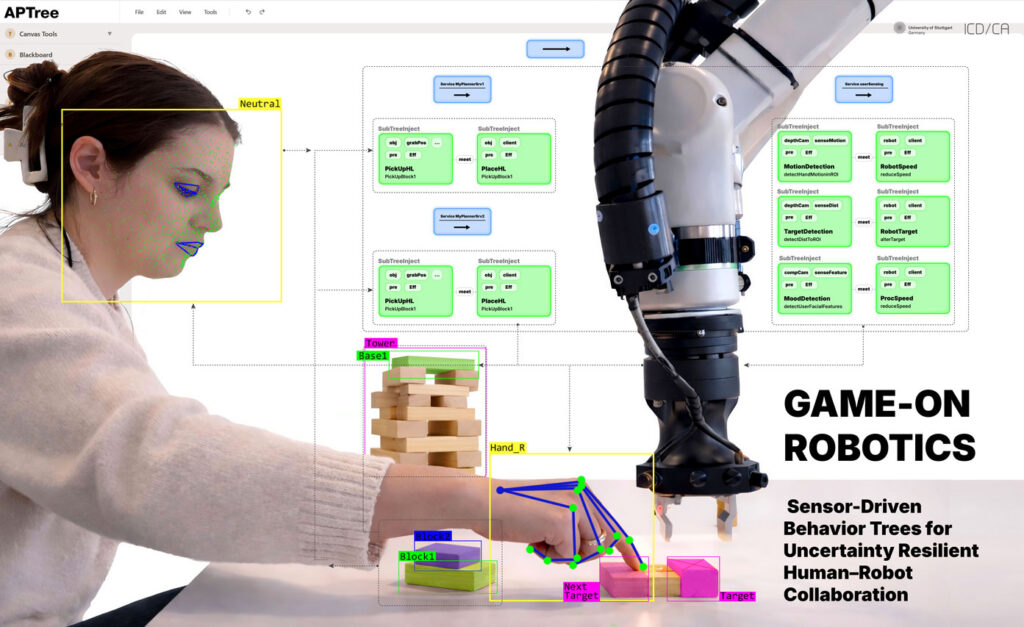
Automated Task Planning (ATP) offers an established framework for generating transparent, reliable task sequences (e.g., “pick a certain object”, “place it at a certain location”) using reasoning-based AI methods. However, ATP methods lack accurate and dynamically updated information of their relevant environment, needed for replanning robot tasks when changes occur. This challenge can be solved by integrating real-time sensing, enabling ATP to update and re-plan. When combined, reasoning and sensing allow robots to respond to their environment, interpret human actions, or respond to unexpected changes—making robotic processes far more resilient.
APTree framework make this dynamic integration possible. It utilizes behavior trees, which are commonly used to dynamically design video game entity behaviors, and integrates ATP methods and sensor data in an accessible method for architects. Real-time sensing continuously informs the automated task planners, enabling contextaware adjustments and strengthening stability and safety in collaborative assembly tasks. Crucially, APTree provides a domain-specific language and interface that allows designers and architects to specify tasks and goals without technical expertise in planning algorithms or robotic control.
This workshop introduces participants to these methods through hands-on experimentation in collaborative robotic fabrication. Attendees will learn to describe fabrication tasks using APTree, generate plans through a range of ATP techniques, and observe how robots adapt during execution using real-time sensor feedback. They will develop a functional, adaptive HRC prototype that integrates planning, sensing, and reactive control, and gain insight into selecting appropriate planning methods for different uncertainty conditions. Through an iterative testing process, participants will explore effective modes of human–robot collaboration that address the demands and constraints of contemporary construction
Participants
SOFTWARE
- Rhino 8, GH
- Adobe Suite (Premiere, Adobe After Effects, Adobe Illustrator, Photoshop, InDesign).
- For the 30-day trial version of Adobe Products, see: www.adobe.com/downloads.html
- Visual Studio Code (latest) and Visual Studio (latest); or: Cursor
HARDWARE
- Windows Laptop (not Mac)
Gili Ron
Gili Ron is affiliated with the International Max Planck Research School for Intelligent Systems (IMPRS-IS). Her research explores sensor- and AI-supported human–robot collaboration (HRC), with a focus on diverse user groups and tested in timber assembly. Grounded in feminist technoscience perspectives, her work investigates how collaborative robotic systems can support human agency, trust, and inclusion. Her work, developed in collaboration with the University of Stuttgart’s School of Social Sciences and industry partners Müller-Blaustein and NEURA Robotics, she evaluated human-centered, sensor-driven HRC in user studies with professional carpenters and academics across varying levels of expertise. Ron holds a Bachelor of Architecture from Tel-Aviv University and a Master of Architecture from the Architectural Association’s Emergent Technologies and Design programme (EmTech), where she developed on-site robotic fabrication methods for arid-region construction.

Shermin Sherkat
Shermin Sherkat is also affiliated with the Institute for Control Engineering of Machine Tools and Manufacturing Units (ISW) and is a member of the Artificial Intelligence Software Academy (AISA), where she has trained over 100 architects in AI and software engineering practices. Her research focuses on automating robot task and motion planning for construction robotics by integrating heterogeneous AI techniques and extended behavior trees. She develops low-code frameworks and domain-specific languages that bridge advanced AI methods with architectural practice, enabling practitioners to deploy automated planning and adaptive robotic workflows without extensive manual coding. Sherkat holds a Master’s degree from the University of Tehran, where her thesis developed a model-driven architectural design assistant software system.
